ARC Raiders Augments: Choose the Layout Your Raid Can Use
An augment changes more than a label on the loadout screen. Inspect its current capacity and functions, then match the arrangement to the actual objective and items you intend to carry.
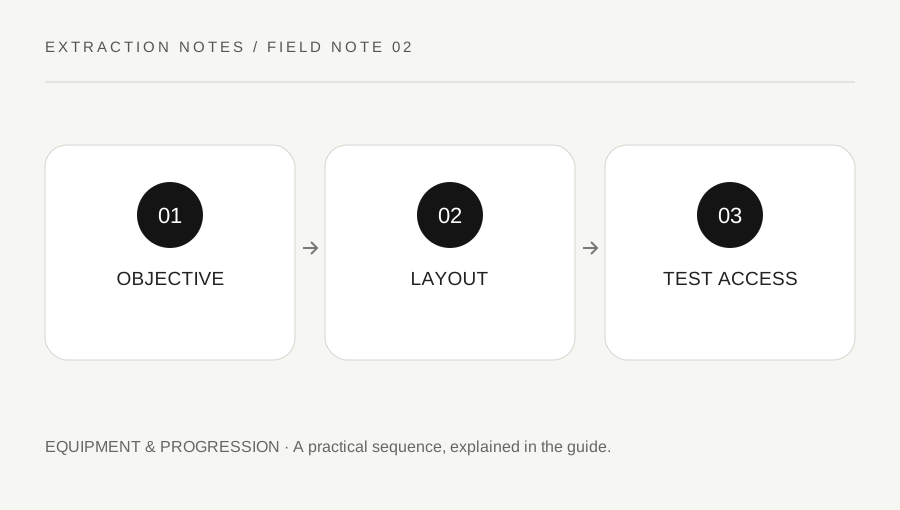
Original explanatory diagram. Examples illustrate a method or decision; they are not claims of personal testing.
Read the current augment description
Embark describes augments as equipment that changes backpack layout and tactical possibilities. Use the current item's details for the exact slots, restrictions and functions. This page does not publish a permanent capacity table that could become outdated.
Write the raid's main task before choosing. A focused collection trip, a quest visit and a combat-oriented session may value different carrying and access arrangements. Rarity alone does not show whether the layout supports the plan.
Keep the augment distinct from the items placed into it. A theoretically suitable layout can still be poorly prepared if the intended utility is missing or arranged where you cannot use it comfortably. Read what is equipped, not only what is owned in the stash.
Map the intended load into the layout
List the essential weapon supplies, recovery items, utilities and expected return cargo. Place the actual items in the supported slots and inspect remaining room. A capacity increase is useful only if the rest of the kit does not immediately consume it without purpose.
Check any item-specific condition in the current interface. Do not assume every slot behaves alike or that an item can be protected or accessed in a way the layout does not permit. Avoid transferring another augment's rule from memory.
For a worked example, a Raider plans a short materials trip but fills the available space with equipment for several unrelated objectives. They simplify the kit and select the layout that supports the single planned route. The improvement comes from task fit, not from calling one augment universally best.
Test access before deployment
Confirm where quick-use items and other frequently needed supplies appear under the current controls. A useful item that requires an unfamiliar sequence during pressure can create a practical problem even if the overall capacity is generous.
Use a low-stakes check of the setup rather than reorganizing for the first time in an exposed raid location. If a binding or interface changed after an update, inspect it before relying on the old motion. Keep the control task separate from a major equipment-value experiment.
In a squad, communicate unusual dependencies, such as relying on another player to carry a shared utility. Do not assume a teammate has the item because the group used that arrangement in the previous session. Confirm the actual kit and let each player understand their own access path.
Review what the layout enabled
After a raid, inspect which slots and functions were useful and which remained occupied without contributing. Keep the outcome in context: a quiet extraction does not prove every carried item was unnecessary, and a loss does not prove the augment was the cause.
Choose one adjustment for the next similar trip, such as preserving room for a specific return item or simplifying a quick-use arrangement. Recheck current descriptions when balance or interface updates affect the equipment.
Finish with the objective, chosen layout and one observed tradeoff. This creates a reusable equipment decision rather than a permanent tier list. The useful augment is the one whose supported functions, carrying arrangement and practical access match the raid you intend to attempt with the resources you can sustain.
A practical checklist
Choices are saved in this browser. Reset them here or clear this site’s browser storage.
Questions that come up
Is the largest capacity always best?
Not automatically. Layout, functions, access and the task can matter as much as a single capacity number.
Are all slots interchangeable?
Do not assume so. Read the current item and interface restrictions.
Does this guide rank every augment?
No. It offers a comparison method and avoids permanent numerical tables or universal best-item claims.
References & scope
Background references checked on 18 October 2026. Worked examples and diagrams are original teaching material.